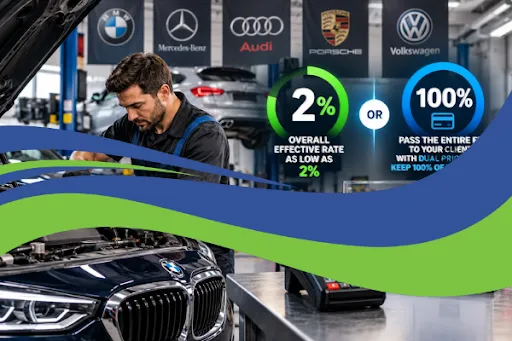
2% Processing vs. Dual Pricing: Which Is Right for Your European Repair Shop?
European auto repair shops work hard to deliver quality repairs, accurate diagnostics, and reliable service for vehicles such as BMW, Mercedes-Benz, Audi, Porsche, Volkswagen, and other European makes. From routine maintenance to complex engine and transmission repairs, providing excellent service requires skilled technicians, specialized equipment, and quality replacement parts.
But while shop owners focus on keeping vehicles running smoothly, one business expense can quietly reduce their profits: credit card processing fees.
Every time a customer pays for a repair using a credit or debit card, the business may incur processing fees. Although these charges may seem small on individual transactions, they can add up to thousands of dollars over time, especially for shops that handle high-value repair orders.
The good news is that European auto repair businesses have payment processing options worth exploring.
Depending on eligibility and the provider's terms, your shop may be able to choose an overall effective processing rate as low as 2% or explore a dual pricing program designed to offset eligible processing costs.
Understanding these options can help you make informed decisions about your expenses, protect your profit margins, and keep more of the revenue your business earns.
Why Credit Card Processing Fees Matter for European Auto Repair Shops
Operating a European auto repair shop comes with unique financial challenges. Specialized diagnostic equipment, manufacturer-specific replacement parts, technician training, insurance, facility expenses, and labor all contribute to the cost of running your business.
For example, diagnosing an issue with a BMW or Mercedes-Benz may require advanced scanning equipment and specialized technical knowledge. A major engine repair or transmission service can involve expensive parts and several hours of labor.
After covering these expenses, your business needs to retain enough revenue to pay operating costs and generate a reasonable profit.
Credit card processing fees can make that more difficult.
Unlike some business expenses that occur occasionally, processing fees may apply to a large portion of your customer transactions. The more card payments your shop accepts, the more important it becomes to understand the total cost of processing those payments.
Consider a shop that processes $100,000 in card payments each month at an overall effective rate of 3%.
That represents $3,000 in monthly processing costs, or $36,000 per year.
For an independent repair shop, that money could potentially support equipment upgrades, technician development, inventory purchases, or other business priorities.
This is why reviewing your payment processing arrangement is worth considering. Even a small reduction in your effective rate can make a meaningful difference when applied to a large volume of transactions.
Option 1: Choose an Overall Effective Processing Rate as Low as 2%
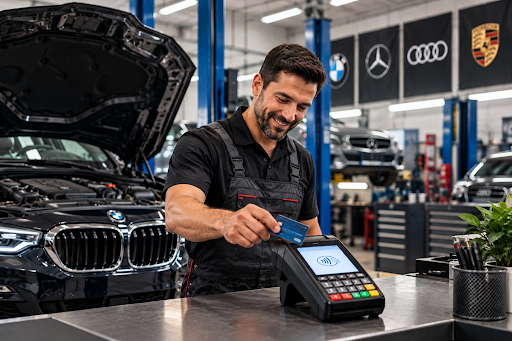
If you prefer to keep your service pricing straightforward for customers, a lower overall effective processing rate may be worth exploring.
An effective rate as low as 2% may be available to qualifying businesses, depending on their transaction volume, card mix, processing agreement, and other factors.
Your overall effective rate measures the total processing fees you pay relative to the total card payment volume you process. It provides a more complete picture of your costs than looking at an advertised transaction rate alone.
How a Lower Effective Rate Can Benefit Your Shop
Reduce operating expenses. Lower processing costs can leave more money available for essential business expenses, including equipment maintenance, inventory, staffing, and facility improvements.
Maintain straightforward customer pricing. You can continue displaying your service prices without introducing a separate dual pricing structure, while managing processing expenses as part of your operating costs.
Improve financial visibility. Reviewing your current effective rate helps you understand what you are actually paying and whether another processing agreement could offer better value.
Support long-term profitability. Reducing recurring expenses may improve your financial position over time, provided the new agreement does not introduce additional costs that offset the savings.
Option 2: Pass Eligible Processing Costs to Customers With Dual Pricing

Another option is dual pricing, a pricing structure that displays different prices for different payment methods, commonly a cash price and a card price.
Instead of absorbing all eligible processing expenses, your shop can explore a properly structured dual pricing program designed to offset those costs.
For businesses that process substantial card payment volume, this approach may provide another way to manage payment expenses and preserve more of the revenue generated by their services.
How Dual Pricing Works in an Auto Repair Shop
Imagine a customer brings an Audi into your shop for a repair. After your technician completes the work, the customer receives the invoice and prepares to pay.
With an appropriately configured dual pricing program, the customer sees the applicable prices for the available payment methods before completing the transaction.
The customer can then choose the payment method that best suits their needs.
For your business, the pricing structure is designed to account for eligible payment processing costs instead of automatically absorbing those expenses.
Clear communication is essential. Customers should understand the applicable prices before authorizing payment, and the pricing shown at checkout should match the disclosed pricing structure.
Dual pricing must also be implemented in accordance with applicable laws, card-network requirements, and the provider's program rules.
Why Auto Repair Shops Consider Dual Pricing
Protect your profit margins. Repair invoices can range from routine maintenance to expensive mechanical repairs. A properly structured dual pricing program may help offset eligible processing costs across your payment volume.
Manage recurring expenses. Rather than treating all eligible processing costs as an expense the business must absorb, you can evaluate a pricing structure designed to account for them.
Keep more revenue available for business needs. Reducing the impact of eligible processing expenses may leave more money available for staffing, inventory, specialized tools, and other operating priorities.
Provide clear payment choices. Transparent pricing helps customers understand their options before paying and can reduce confusion at checkout.
What Does Keeping 100% of Your Money Mean?

The idea behind keeping 100% of your money is to avoid absorbing eligible processing costs when a properly structured dual pricing arrangement offsets those expenses.
However, it is important to understand what this means in practice.
Dual pricing does not guarantee that every transaction will be free of payment-related expenses. The outcome depends on the program's structure, eligible transactions, customer payment choices, and any remaining provider charges.
Your business will still have operating expenses, and your payment processor may charge fees under the program agreement.
Before implementing dual pricing, ask your provider to explain how the pricing works, which costs are offset, what charges remain, and how the program appears on estimates, invoices, and receipts.
The goal is to find a compliant payment processing solution that helps your shop manage expenses while maintaining transparent customer pricing.
Lower Processing Rates vs. Dual Pricing: Which Option Is Right for You?
Both options can help your European auto repair shop approach processing expenses more strategically. However, they work differently and may suit different business needs.
A Lower Effective Rate May Be Right for Your Shop If:
You want to maintain one straightforward price for your repair services.
You prefer to absorb processing expenses as part of your operating costs.
You want to reduce processing costs without changing your pricing presentation.
You value a familiar checkout experience for your customers.
Dual Pricing May Be Worth Exploring If:
Your shop processes a substantial volume of card payments.
You want to offset eligible processing costs through a different pricing structure.
You are comfortable displaying prices for different payment methods.
You want to evaluate an alternative to absorbing all processing costs.
Your business qualifies for a compliant dual pricing program.
There is no single solution that works best for every shop.
An independent garage with modest transaction volume may prioritize simple pricing and predictable expenses. A larger European auto repair facility handling numerous high-value invoices each day may be more interested in understanding how different pricing structures affect its total processing costs.
The best choice depends on your current effective rate, transaction volume, customer expectations, and the complete terms of the available programs.
A Practical Example of Processing Costs for an Auto Repair Shop
Let's look at a hypothetical European auto repair business that processes $100,000 in card payments every month.
At a 3% effective rate, the shop pays approximately $3,000 per month in processing costs.
Over a year, that totals $36,000.
If the business qualifies for a 2% effective rate, its estimated processing costs would decrease to $2,000 per month, assuming the same processing volume and no additional costs.
That would represent a potential difference of $12,000 per year.
Alternatively, the owner could investigate a dual pricing program to determine whether eligible processing expenses could be offset through the pricing structure.
The financial outcome of dual pricing would depend on the program's terms, eligible transactions, customer payment choices, and any remaining fees.
These examples demonstrate why it is important to review your processing statement rather than assume your current arrangement is the most cost-effective option.
What to Look for in a Payment Processing Provider
Choosing a payment processor involves more than finding the lowest advertised rate. Your solution should support your daily operations, provide clear pricing, and help you understand the actual cost of accepting payments.
Here are several factors European auto repair shop owners should consider.
1. Transparent Pricing
Ask for a complete breakdown of processing expenses, including transaction charges, monthly fees, equipment costs, and any additional applicable charges.
Make sure you understand how the proposed effective rate is calculated and whether it reflects your expected total processing costs.
2. Compatibility With Your Shop's Operations
Your payment system should work with your existing terminals, repair orders, point-of-sale system, or shop management software.
A solution that fits your current workflow can help your team collect payments efficiently and reduce unnecessary administrative work.
3. Clear Customer Payment Options
If you choose dual pricing, make sure your provider explains how the applicable prices will be displayed before payment.
The pricing should be clearly communicated and consistently reflected in your estimates, invoices, payment terminals, and receipts.
4. Reliable Payment Acceptance
Customers expect a convenient way to pay after their vehicle has been serviced. Your payment system should support efficient transactions and help minimize unnecessary disruptions at checkout.
5. Responsive Customer Support
When payment equipment stops working or a transaction requires assistance, delays can affect your front desk and customer experience.
Ask about technical support availability and the process for resolving payment issues.
6. A Review of Your Current Processing Statement
Before switching providers, compare your current statement with the proposed agreement.
Review your actual effective rate, recurring charges, equipment expenses, contract terms, and any potential termination fees.
A lower advertised rate is not necessarily the least expensive option if other charges increase your total costs.
Important Considerations Before Choosing Dual Pricing
Dual pricing and credit card surcharging are different arrangements and may be subject to different requirements.
Before implementing a program, make sure you understand the applicable rules and how they affect your business.
Check applicable laws. Requirements may vary by state and jurisdiction.
Understand card-network rules. Confirm the requirements for relevant card networks and payment methods.
Display prices clearly. Customers should understand the applicable prices before authorizing payment.
Configure your payment system correctly. Ensure the system applies the disclosed prices accurately and generates appropriate receipts.
Review all remaining costs. Confirm whether monthly fees, equipment charges, or other expenses still apply.
For example, Visa's U.S. guidance distinguishes cash discounts from credit card surcharges and establishes specific requirements for surcharging. Its rules also address debit and prepaid cards. Review the current Visa merchant surcharging guidance before selecting a program.
Businesses should also review applicable consumer protection and pricing disclosure requirements, including the Federal Trade Commission's guidance on fees and pricing disclosures.
A knowledgeable payment provider can help you understand the available options, but you should confirm that the selected program complies with all applicable requirements.
Frequently Asked Questions About European Auto Repair Payment Processing
Can a European auto repair shop qualify for an overall effective rate as low as 2%?
Possibly. An effective rate as low as 2% may be available to qualifying businesses, but the actual rate depends on transaction volume, card mix, provider pricing, and the processing agreement. Request a quote based on your shop's current processing activity.
Can dual pricing eliminate all credit card processing costs?
A properly structured dual pricing program may offset eligible processing costs, but it does not automatically eliminate every payment-related expense. The outcome depends on the program, eligible transactions, customer payment choices, and any remaining charges.
Will dual pricing affect my customers?
It may influence which payment method customers choose. Clear communication and transparent pricing can help customers understand their options before paying.
How do I calculate my current effective processing rate?
Divide the total processing fees charged during a specific period by the total card payment volume processed during that same period, then multiply by 100.
For example, if your shop pays $1,500 in processing fees on $50,000 in card payments, your effective processing rate is 3%.
Should I switch payment processors immediately?
Not without comparing the complete costs. Review your current agreement, any termination fees, equipment expenses, integration requirements, and the expected savings before making a decision.
Take Control of Your European Auto Repair Shop's Payment Processing Costs
Running a European auto repair shop requires significant investment in skilled technicians, specialized equipment, quality parts, and customer service. Managing payment processing expenses is another opportunity to improve financial visibility and protect your profit margins.
Whether you prefer an overall effective processing rate as low as 2% or want to explore dual pricing to offset eligible processing costs, understanding your options is the first step.
Review your merchant processing statement. Compare your total fees with your monthly card payment volume. Then evaluate the available solutions based on your actual costs, customer expectations, and business goals.
You may discover that a different payment processing arrangement could help you reduce overhead, retain more revenue, and make better use of the money your business earns.
Ready to Explore a Payment Processing Solution for Your European Auto Repair Shop?
Your shop works hard to deliver reliable repairs and quality service. Your payment processing arrangement should support your business goals, too.
Explore your options for managing processing costs, whether that means pursuing a competitive effective rate or evaluating a properly structured dual pricing program.
Take the next step toward smarter payment processing for your business.
Visit ECI SecurePay to explore payment processing options and learn more about a solution that may fit your European auto repair shop's needs.
Explore your options today: https://ecisecurepay.com/eciezpay
Rates, eligibility, and potential savings vary by provider, transaction profile, and agreement. Dual pricing and credit card surcharging have different requirements. Confirm applicable laws, card-network rules, and all program costs before implementation.
