
How to Lower Your Credit Card Processing Fees: A Guide for Small Business Owners
Credit card processing fees are one of those business costs that can quietly eat into your profits often without you fully realizing how much you're paying. For small business owners, even a fraction of a percentage point can add up to thousands of dollars over the course of a year.
The good news: you have more control over your processing costs than you might think. Here's a practical guide to understanding where these fees come from and what you can do to reduce them.
Understanding How Processing Fees Work
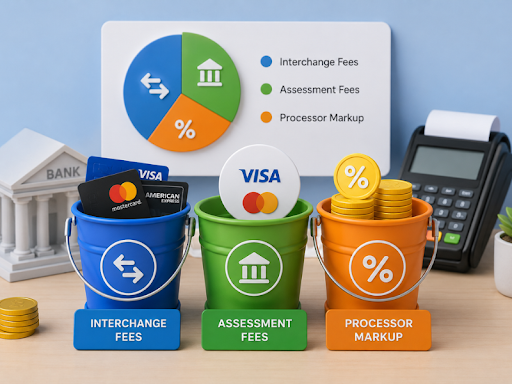
Before you can lower your fees, it helps to understand what you're actually paying for. Most credit card processing costs fall into three buckets:
Interchange feesare set by the card networks (Visa, Mastercard, etc.) and paid to the card-issuing bank. These are non-negotiable because no processor can change them. They vary based on card type (debit, rewards, corporate) and how the transaction is processed.
Assessment feesare also set by the card networks and go directly to them. Like interchange, these are fixed.
Processor markupis where your merchant services provider makes their money. This is the portion that is negotiable and where smart business owners focus their attention.
Understanding this breakdown helps you identify which fees you can influence and which you can't.
1. Know Your Transaction Type: Swiped vs. Keyed
One of the most impactful and overlooked ways to control your fees is making sure your account is set up correctly for how you actually do business.
Swiped (card-present) transactionscarry lower interchange rates because the card is physically present, reducing fraud risk.
Keyed (card-not-present) transactionswhere you manually type in a card number are considered higher risk and carry higher fees.
If your business is primarily face-to-face (retail, restaurant, service counter), make sure you're set up as a card-present merchant and that you're swiping, dipping, or tapping cards rather than keying them in. Processing more than 30% of your transactions as keyed when you're set up as a swiped account can result in higher rates, held funds, or even account termination.
Action step:Review your monthly processing statement and look at the ratio of swiped to keyed transactions. If it doesn't match your actual business model, contact your merchant services provider to discuss a correction.
2. Use the Right Equipment and Software
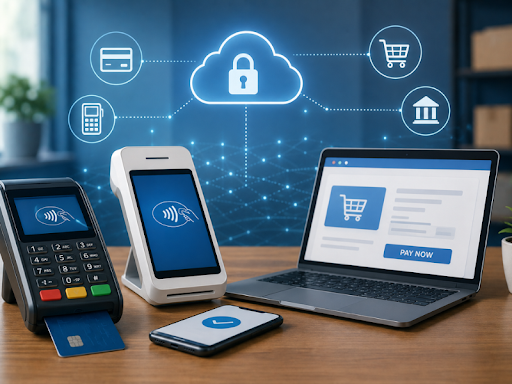
Outdated payment terminals can prevent you from taking advantage of lower-cost transaction types. Modern EMV chip readers, NFC contactless terminals, and up-to-date payment gateways all help ensure transactions qualify at the lowest possible interchange tier.
For e-commerce businesses, your payment gateway plays a critical role. The right gateway, one compatible with your shopping cart and correctly configured, ensures transactions are processed cleanly and qualify at standard rates rather than being "downgraded" to more expensive tiers.
Action step:If you're using equipment more than three to four years old, it may be time to evaluate an upgrade. The savings in interchange qualification can often offset the cost quickly.
3. Qualify for Level 2 or Level 3 Processing (B2B)
If your business primarily sells to other businesses or to government entities, you may be leaving significant savings on the table by not using Level 2 or Level 3 processing.
Level 2 processingrequires you to submit additional data with each transaction (such as tax amounts and customer codes). In exchange, you receive a lower interchange rate.
Level 3 processingrequires even more line-item detail (product codes, quantities, descriptions) and offers the deepest discounts, often saving 0.5% to 1.5% per transaction compared to standard rates.
To qualify, you'll need payment software certified to collect the right data, and your processor needs to support it. But for B2B companies processing significant volume, the savings can be substantial.
Action step:Ask your merchant services provider whether your transactions qualify for Level 2 or Level 3 rates and what equipment or software you'd need to take advantage of them.
4. Reduce Chargebacks
Chargebacks, when a customer disputes a charge with their bank, hurt your business in more ways than one. You lose the sale, you pay a chargeback fee (typically $15–$50 per incident), and too many chargebacks can raise your risk profile with your processor, leading to higher rates or account termination.
Keeping your chargeback ratio below 1% is critical. Here's how:
Use clear billing descriptors. Make sure your business name on the customer's statement is recognizable. Confusing descriptors lead to "friendly fraud" disputes.
Get authorization and signatures. For card-present transactions, always get a signature when required.
Respond to disputes promptly. Most processors give you a short window (often 7–10 days) to contest a chargeback with documentation.
Use Address Verification (AVS) and CVV checks for card-not-present transactions to flag potentially fraudulent orders before they ship.
Action step:Pull your chargeback report and identify any patterns such as recurring customers, specific products, or fulfillment gaps that might be driving disputes.
5. Add Encryption and Tokenization
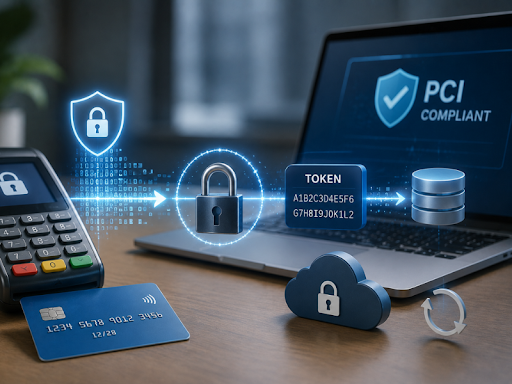
Beyond reducing fraud-related losses, protecting your customers' payment data with encryption and tokenization can also help you qualify for better processing terms and reduce your PCI compliance burden.
Encryptionscrambles card data at the point of capture so it's never transmitted in a readable form.
Tokenizationreplaces card numbers with a unique token for storage and recurring billing, so actual card data never sits in your system.
Together, these tools protect your customers, reduce your liability, and can lower your scope for PCI compliance, which translates to lower compliance fees and reduced risk exposure.
6. Negotiate Your Processor Markup
Many small business owners don't realize that the markup portion of their processing rate is negotiable especially as their processing volume grows.
If you've been with your processor for a year or more, or if your monthly volume has increased significantly, it's worth having a conversation about your rates. Come prepared with:
Your current monthly volume
Your average ticket size
A recent processing statement showing your effective rate
Even a 0.10% reduction in your effective rate can save hundreds or thousands of dollars annually depending on your volume.
Action step:Schedule an annual rate review with your merchant services provider. A reputable processor will be willing to have this conversation.
7. Choose the Right Pricing Model
Not all pricing structures are created equal. The four most common models are:
Dual pricing:You post two prices, a cash price and a card price, so customers who pay with a card cover the processing cost, while cash-paying customers get a small discount. This model effectively eliminates processing fees for the business and is fully compliant when implemented correctly. It's increasingly popular with retailers, restaurants, and service businesses.
Interchange-plus pricing:You pay the actual interchange cost plus a fixed markup. This is the most transparent model and a solid option for businesses that prefer a single posted price.
Tiered pricing:Transactions are grouped into "qualified," "mid-qualified," and "non-qualified" tiers with different rates. It's simpler to read but can be harder to optimize.
Flat-rate pricing:A single rate for all transactions (popular with services like Square). Predictable but often not the most cost-effective for higher-volume businesses.
For most small businesses, dual pricing is the best way to eliminate not just reduce processing costs while staying competitive and compliant.
The Bottom Line
Lowering your credit card processing fees isn't about finding a magic solution. It's about understanding your costs, setting up your account correctly, using the right tools, and building a relationship with a merchant services provider who's invested in your success.
At ECI Secure Pay, we work with small businesses across the country to ensure they're not overpaying for payment processing. Whether you're just getting started or ready to evaluate your current setup, our team can walk you through your options.
Ready to find out if you're overpaying? Contact ECI today for a free rate review.
Electronic Commerce International (ECI) is a full-service merchant services provider offering credit card processing, payment gateways, POS equipment, and more. Call us at 888-404-7500 or email [email protected].
