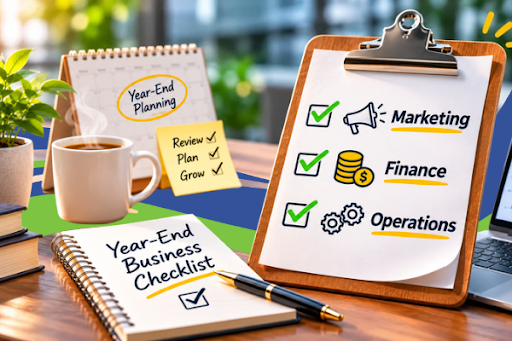
A Small Business Owner’s Year-End Checklist: Marketing, Finance, and Operations
The end of the year is more than a time to celebrate business milestones. It is also an opportunity to review what worked, identify areas that need improvement, and prepare your business for a stronger year ahead.
For small business owners, the final months of the year can be especially busy. Between managing holiday sales, handling customer requests, reviewing expenses, and planning upcoming campaigns, important business tasks can easily get overlooked.
That is why having a small business year-end checklist can make a difference.
A structured year-end review helps you understand your business performance, organize your finances, improve daily operations, and set realistic goals for the coming year.
Whether you run a retail store, an online business, a professional service company, or a growing local business, here are the essential areas to review before the year ends.
1. Review Your Marketing Performance
Your marketing strategy plays an important role in attracting customers and generating revenue. Before planning next year's campaigns, take time to evaluate your current marketing efforts.
Instead of simply looking at how many posts you published or how much you spent on advertising, focus on the results your marketing activities actually produced.
Your year-end marketing checklist:
Review website traffic and identify your top-performing pages.
Check your Google Analytics and Google Search Console performance.
Review social media engagement, reach, and follower growth.
Identify which marketing campaigns generated the most leads and sales.
Evaluate your email marketing open rates, click-through rates, and conversions.
Review your customer acquisition costs and marketing expenses.
Update outdated website content, service pages, and promotional offers.
Check your Google Business Profile and respond to outstanding customer reviews.
Identify marketing channels that deserve more attention next year.
Ask yourself:
Which marketing channels brought in the most customers?
Which campaigns generated actual revenue?
Are you reaching the right target audience?
Are you spending money on marketing activities that are not producing results?
Plan Your Marketing Strategy for the New Year
Once you understand your marketing performance, create a plan for the next 12 months.
Set measurable goals, such as increasing website traffic, generating more qualified leads, improving customer retention, or increasing repeat purchases.
You should also prepare a basic marketing calendar that includes seasonal promotions, important business dates, content topics, email campaigns, and product or service launches.
The goal is to start the new year with a clear marketing direction rather than figuring everything out as you go.
2. Review Your Business Finances
Your financial performance tells an important story about your business. A company can generate strong sales but still struggle with profitability if expenses, unpaid invoices, and operational costs are not properly managed.
Year-end is a good time to review your financial records and understand where your money is coming from and where it is going.
The IRS recommends maintaining accurate business records to monitor performance, prepare financial statements, identify income sources, track deductible expenses, and support tax reporting.
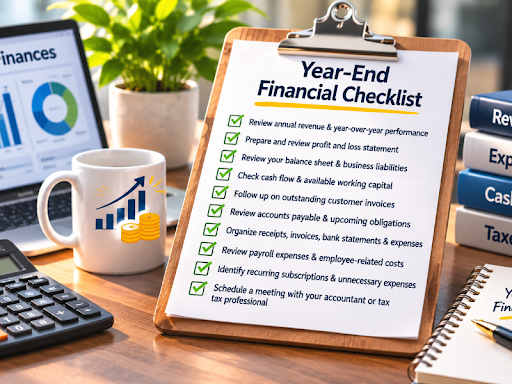
Your year-end financial checklist:
Review your annual revenue and compare it with your previous year's performance.
Prepare and review your profit and loss statement.
Review your balance sheet and current business liabilities.
Check your cash flow and available working capital.
Identify outstanding customer invoices and follow up on unpaid balances.
Review accounts payable and upcoming financial obligations.
Organize receipts, invoices, bank statements, and expense records.
Review payroll expenses and other employee-related costs.
Identify recurring subscriptions and unnecessary business expenses.
Schedule a meeting with your accountant or tax professional.
Understand Your Profit Margins
Revenue alone does not determine whether your business is financially healthy.
For example, if your business generates $100,000 in annual revenue but spends $85,000 on operating costs, your remaining profit before other applicable adjustments is $15,000.
Reviewing your profit margins helps you understand whether your current pricing, expenses, and business model are sustainable.
Look for opportunities to reduce unnecessary expenses, negotiate better vendor terms, and improve how your business manages incoming payments.
Review Your Payment Processing Costs
Payment processing is another important part of your financial review.
If your business accepts credit cards, debit cards, or online payments, take time to review your processing statements and understand how much you are paying in transaction fees and other charges.
Consider the following:
Are your current processing rates competitive?
Are there monthly or additional service fees?
Are your payment methods convenient for your customers?
Can you simplify payment collection and reconciliation?
Are you using payment technology that supports your current business needs?
Even small differences in recurring business expenses can add up over time.
Reviewing your payment processing setup can help you identify opportunities to improve cash flow management and keep more of your business revenue.
3. Evaluate Your Business Operations
Efficient operations help your business serve customers, manage employees, and complete daily tasks without unnecessary delays.
However, processes that worked when your business was smaller may no longer be effective as your company grows.
Use the end of the year to identify operational problems and determine what needs to change.
Your year-end operations checklist:
Review your daily business processes and workflows.
Identify repetitive tasks that could be automated.
Review employee responsibilities and performance.
Update internal procedures and standard operating procedures (SOPs).
Evaluate your inventory levels and identify slow-moving products.
Review vendor and supplier agreements.
Check your business equipment and technology.
Review software subscriptions and remove tools you no longer need.
Update employee access and permissions for business systems.
Review data backups, cybersecurity practices, and account security.
Identify Tasks You Can Automate
Small business owners often spend too much time handling repetitive administrative work.
Tasks such as appointment reminders, customer follow-ups, invoice notifications, email marketing, and lead management can often be automated.
Automation allows your team to spend less time on manual tasks and more time focusing on customers and business growth.
Start by identifying three repetitive tasks that take up the most time. Then determine whether an existing software tool or automated workflow can help simplify them.
You do not need to automate everything at once. Focus on the processes that will make the biggest difference to your daily operations.
4. Review Customer Experience and Retention
Your existing customers are an important part of your business success. While attracting new customers is essential, retaining the people who already trust your products or services can also support long-term revenue.
Before the year ends, evaluate how customers interact with your business.
Your customer experience checklist:
Review customer feedback, complaints, and suggestions.
Check your online reviews and business reputation.
Identify common customer service issues.
Review response times for emails, calls, and inquiries.
Follow up with inactive or previous customers.
Evaluate your loyalty and referral programs.
Review your checkout and payment experience.
Identify ways to make purchasing easier for customers.
Make Payments Easier for Your Customers
A smooth payment experience is an important part of customer satisfaction.
Customers expect convenient and reliable ways to pay, whether they are purchasing in person, ordering online, or paying for services remotely.
Review whether your current payment system supports the ways your customers prefer to transact.
Consider whether your business could benefit from integrated payment processing, mobile payment acceptance, online checkout options, or simplified payment collection.
Small improvements to the purchasing process can help reduce friction and create a better customer experience.
5. Review Your Technology and Business Tools
The tools you use every day can either support business growth or create unnecessary complications.
Year-end is a good opportunity to evaluate whether your current technology is still meeting your needs.
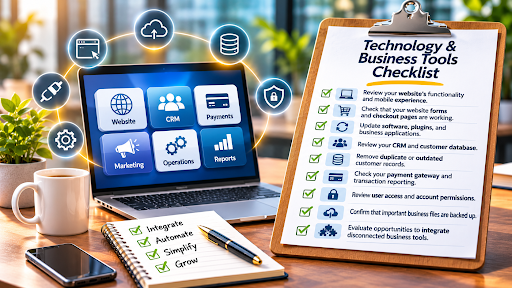
Your technology checklist:
Review your website's functionality and mobile experience.
Check that your website forms and checkout pages are working.
Update software, plugins, and business applications.
Review your CRM and customer database.
Remove duplicate or outdated customer records.
Check your payment gateway and transaction reporting.
Review user access and account permissions.
Confirm that important business files are backed up.
Evaluate opportunities to integrate disconnected business tools.
Consider whether you are using too many separate platforms to manage payments, customers, marketing, and daily operations.
Having connected systems can help reduce manual work, improve visibility, and make it easier to manage business activities.
6. Set Clear Business Goals for the New Year
Once you have reviewed your marketing, finances, and operations, it is time to decide where you want your business to go next.
Avoid setting goals simply because they sound impressive. Your goals should be based on your actual business performance, available resources, and growth opportunities.
Your business planning checklist:
Set a realistic annual revenue target.
Establish monthly or quarterly sales goals.
Identify your most profitable products or services.
Set customer acquisition and retention targets.
Establish a marketing budget.
Plan upcoming campaigns and promotions.
Identify opportunities to expand your products or services.
Determine whether you need additional employees or resources.
Create a plan for improving business efficiency.
Schedule quarterly business performance reviews.
Turn Your Goals Into an Action Plan
A business goal is only useful when you know how to achieve it.
Break your annual goals into smaller quarterly objectives and assign responsibilities to the people involved.
For example:
Goal: Increase annual revenue by 15%.
Possible action steps:
Improve conversion rates on your website.
Launch targeted marketing campaigns.
Strengthen customer retention efforts.
Review pricing and operating expenses.
Improve payment collection and checkout processes.
Track your progress every month so you can identify problems early and adjust your strategy when necessary.
7. Review Your Business Payment Solutions

As you prepare for the new year, do not overlook one of the most important parts of running a business: getting paid.
Your payment processing system affects how customers complete purchases, how transactions are managed, and how much you spend on processing fees.
If you have been using the same payment provider for several years, it may be worth reviewing whether your current setup still makes sense.
Here are a few things to consider:
Payment Processing Costs: Review your processing statements and understand the fees associated with accepting different payment methods.
Payment Flexibility: Make sure customers have convenient options for paying online, in person, or on the go.
Transaction Management: Look for tools that make it easier to track transactions, review payments, and manage reporting.
Business Growth: Consider whether your payment provider can support your business as transaction volume increases.
Integrated Technology: Explore solutions that connect payment processing with customer management and marketing tools.
A payment solution should do more than simply process transactions. It should support your business operations and make it easier to manage your revenue.
Final Thoughts: Finish the Year Organized and Start the New Year Prepared
End-of-year business planning does not have to be complicated. What matters is taking the time to understand your current performance and making informed decisions about what comes next.
By reviewing your marketing results, organizing your financial records, improving operations, evaluating customer experiences, and setting measurable goals, you can enter the new year with a clearer direction.
Use this small business year-end checklist as a starting point. Work through each section, prioritize the areas that need attention, and turn your findings into an actionable business plan.
Remember, business growth is not just about generating more sales. It is also about managing expenses, improving processes, delivering better customer experiences, and choosing the right tools to support your goals.
Ready to Make Your Business More Efficient?
As you plan for the year ahead, take a closer look at how your business handles payments and manages growth.
Electronic Commerce International (ECI) helps businesses bring payment processing and marketing technology together through solutions designed to simplify transactions, support customer engagement, and improve business efficiency.
From payment processing and online transactions to marketing automation and customer management tools, ECI offers solutions to help businesses operate smarter.
Don't wait until the new year to start making improvements.
Visit Electronic Commerce International to explore payment and business growth solutions for your company.
